Who needs this step?
- String inverter — yes. All your panels on an MPPT input share one operating voltage.
- Hybrid inverter — yes. Same string rules as a string inverter (plus battery wiring later in step 8).
- Microinverters — largely skip. The inverter under each panel handles voltage on its own.
You should already have a shortlisted panel model and inverter type from Step 6 — Choosing an inverter. Step 7 is not about picking brands — it is about checking the electrical fit before you lock how many panels sit on each string.
The two checks (in plain English)
- Cold mornings — do not over-voltage. Panel voltage rises when it is cold. Add up the panels in series and check the string's open-circuit voltage (Voc) at your site's coldest expected temperature. It must stay below the inverter's maximum DC voltage — or the inverter can shut down or be damaged.
- Hot afternoons — stay inside MPPT. Operating voltage falls when panels are hot in the sun. Check the string's minimum power voltage (Vmp) at your hottest expected cell temperature. It must stay inside the inverter's MPPT window (between MPPT min and MPPT max) or the inverter cannot track maximum power.
- Series vs parallel: panels wired in series add voltage; parallel strings add current. This step is mostly about how many panels you put in one series string on each MPPT input.
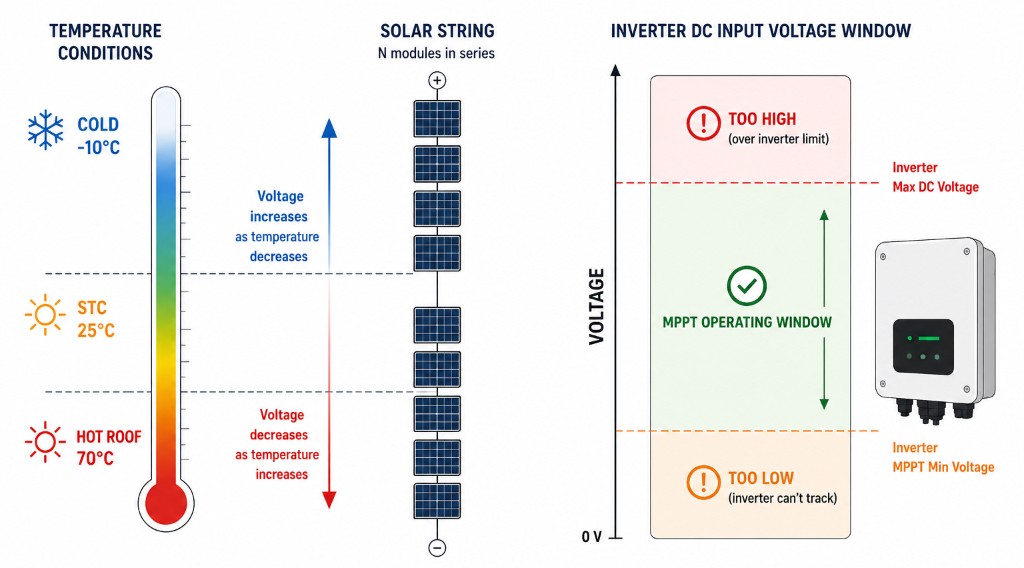
Voltage Calculation in Photonik
Gather these from the panel and inverter datasheets (or our panel and inverter directories):
- From the panel: Voc and Vmp at standard test conditions, and the temperature coefficient of Voc (usually a small negative % per °C).
- From the inverter: MPPT minimum voltage, MPPT maximum voltage, and maximum DC input voltage (the hard ceiling).
- From your site: a realistic minimum and maximum temperature range for where the array will sit (or use defaults and refine later).
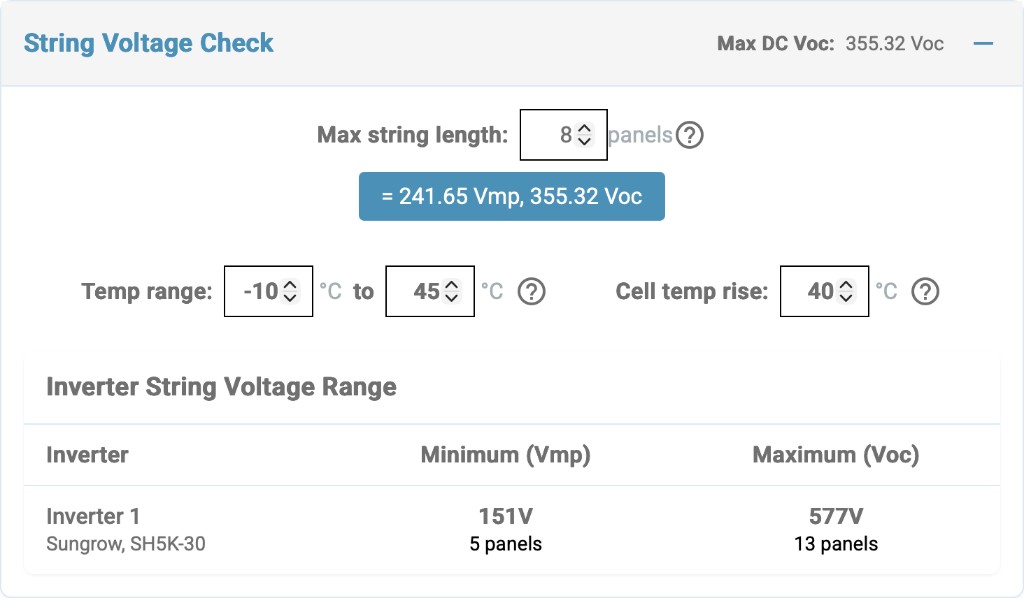
In Photonik Pro, open System Design → String Voltage Check. Set max string length, site temperature range, and cell temperature rise — read calculated Vmp and Voc against each inverter’s minimum and maximum columns.
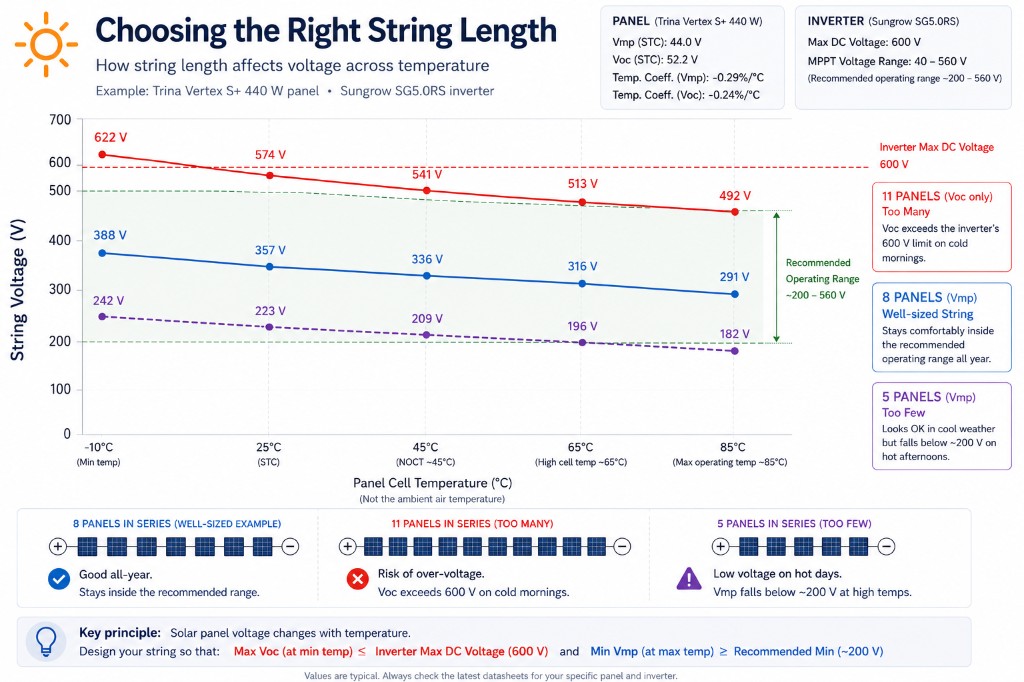
Without Pro, use the string voltage calculator or follow the string voltage walkthrough.
Ready for storage? Step 8 — Battery storage covers whether and how to add a battery.
DC:AC ratio (a quick concept)
Inverters are sold with an AC power rating (e.g. 5 kW), but you can often attach more panel DC capacity than that nameplate — sometimes 1.2× to 1.5× or more, depending on climate and inverter limits. That ratio is called DC:AC ratio (or oversizing).
- Why do it? Panels rarely hit their lab rating in the real world. A modest oversize captures more energy in good conditions without changing the inverter box.
- Why not go wild? Too much DC for the inverter means more clipping on sunny days (power the panels could make but the inverter cannot export). The inverter and local rules still cap what you can connect.
- For this step: DC:AC ratio is a sizing conversation for later — step 7 is about whether a given string length is electrically valid, not about maximising kW on the roof.